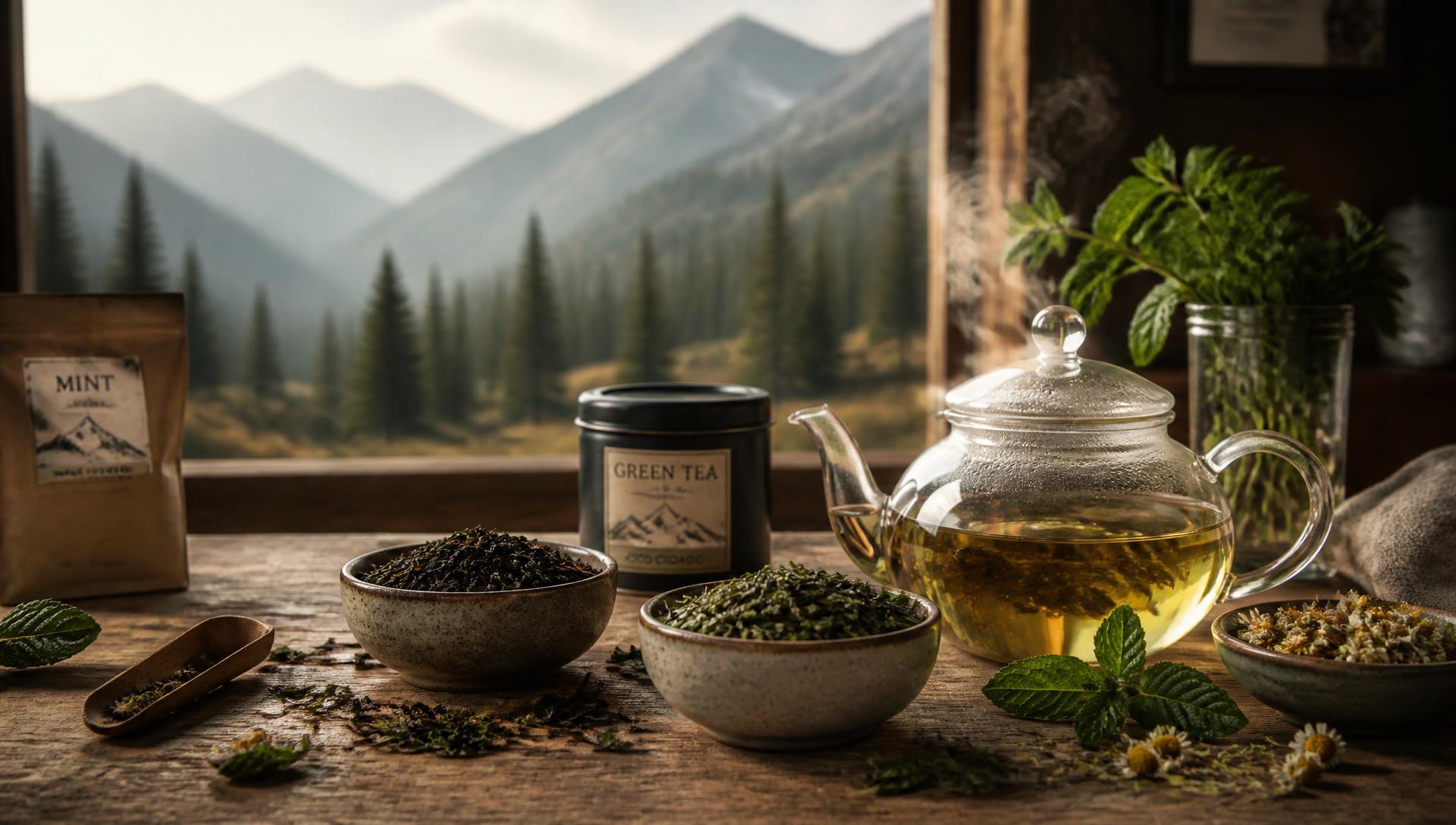
This guide exists because I moved to Pagosa Springs and my tea got worse overnight, with no other variable changed. The kettle, the leaf and the water were the same. The elevation was not.
What actually changes
Water boils when its vapour pressure matches the surrounding air pressure. Higher up, air pressure is lower, so boiling happens at a lower temperature. The water is still boiling — visibly, audibly boiling — it is simply not as hot. At my house, a full rolling boil tops out at roughly 199 °F.
For a black tea whose brewing chart assumes 212 °F, that thirteen-degree shortfall shows up as a thinner, slightly sour cup. Extraction of the heavier compounds slows down, and a three-minute steep now behaves like a two-and-a-half-minute steep.
Boiling point by elevation
| Elevation | Boiling point | Example | Add to steep |
|---|---|---|---|
| Sea level | 212 °F | Boston | — |
| 1,000 ft | 210 °F | Nashville | — |
| 3,000 ft | 206 °F | Flagstaff foothills | +15 s |
| 5,280 ft | 202 °F | Denver | +30 s |
| 7,100 ft | 199 °F | Pagosa Springs | +45 s |
| 9,000 ft | 195 °F | Leadville area | +60 s |
The corrections we use
Black tea and puerh: add 30–60 seconds to the published time, depending on elevation. Alternatively add half a gram of leaf and keep the clock the same. We prefer the extra leaf — long steeps of black tea start pulling tannin.
Oolong: add roughly 20 seconds per gongfu round, or 30 seconds to a western steep. Roasted oolongs need the correction more than light ones.
Green and white: essentially no correction needed. Your target was always below boiling.
Herbal: add a full minute and keep the mug covered. Tisanes are the most heat-dependent thing in the cupboard.
One thing that does not help: leaving the kettle on longer. Once water reaches its boiling point it will not get hotter no matter how long it boils, and all you achieve is driving off dissolved oxygen. Every scored review on this site notes both our elevation and the correction applied, so the numbers translate to wherever you are.
Who this affects
Roughly anyone above about 3,000 feet, which covers most of Colorado, large parts of Utah, New Mexico, Wyoming, Montana and Arizona, plus mountain communities across the country. If your tea has always tasted slightly weaker than the descriptions suggest and you live somewhere high, this is very likely the reason. It took me two frustrated months to work it out.