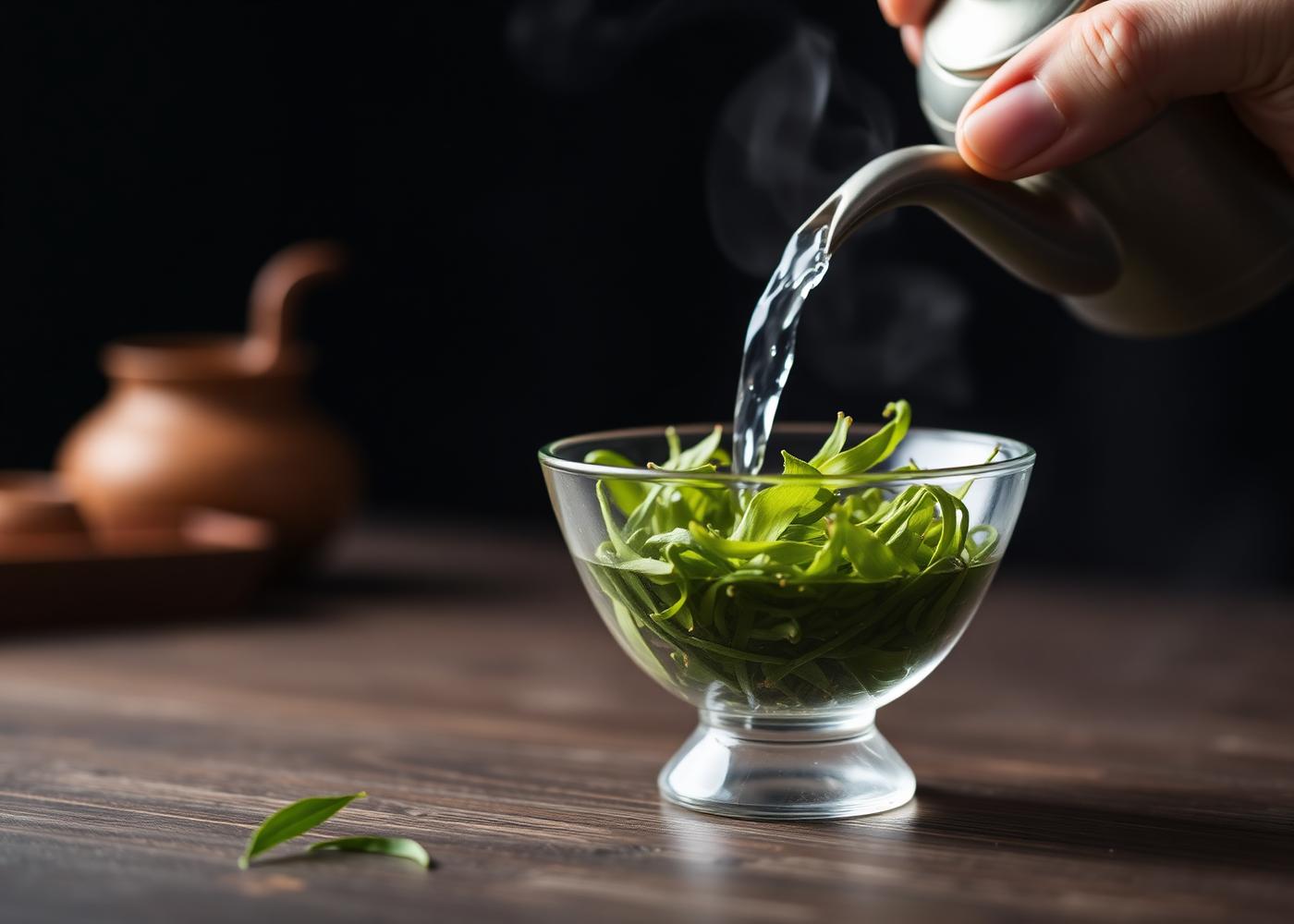
“Green tea has less caffeine than black tea” is the most repeated claim in tea writing and it is only sometimes true. The caffeine in your cup depends far more on how you brewed it than on the colour of the leaf.
The myth worth retiring
All true tea comes from Camellia sinensis, and the caffeine is in the leaf before any processing happens. Oxidation — the step that turns green tea into black tea — does not meaningfully destroy caffeine. What actually drives the number in the cup is extraction: temperature, time and how much leaf you used.
Because black tea is brewed at boiling for three or four minutes and green tea is brewed cooler and shorter, black tea usually delivers more caffeine per cup. That is a brewing convention, not a property of the leaf. Brew a gyokuro at 4 g per 6 oz and you will comfortably out-caffeinate a weak breakfast tea.
Realistic per-cup numbers
| Preparation | Typical caffeine | Comparison |
|---|---|---|
| Drip coffee, 8 oz | 95–165 mg | Baseline |
| Matcha, 2 g whisked | 60–70 mg | ~half a coffee |
| Black tea, 3 g, 4 min | 45–70 mg | ~third of a coffee |
| Gyokuro, 4 g, 2 min | 45–65 mg | High for a green |
| Oolong, 3 g, 3 min | 35–55 mg | Moderate |
| Sencha, 2 g, 70 s | 25–40 mg | Modest |
| White, 3 g, 5 min | 25–45 mg | Varies widely |
| Hojicha, 3 g, 30 s | 7–15 mg | Roasting drives it down |
| Herbal tisane | 0 mg | Not tea at all |
These are ranges taken from published food-composition data and they overlap heavily on purpose. Anyone quoting a single precise figure for “a cup of green tea” is guessing.
What you can actually control
Leaf quantity. The most direct lever. Double the leaf, roughly double the caffeine. Halving your dose and steeping slightly longer gives a lighter cup with a similar flavour profile.
Steep time. Caffeine extracts fast — a large share of it leaves the leaf in the first sixty seconds of a hot steep. This is why the old “rinse the leaf to decaffeinate it” trick partly works, though it also strips flavour and it is nowhere near complete. Do not rely on it if caffeine is a medical concern for you.
Temperature. Cooler water extracts less caffeine. A cold brew left in the fridge overnight can come out at under a third of the caffeine of the same leaf brewed hot, and tastes sweeter for the same reason.
Later infusions. With gongfu-style brewing, the third and fourth infusions carry considerably less caffeine than the first while still tasting excellent. Afternoon oolong is a genuinely sensible habit.
Genuinely low-caffeine options
- Hojicha. Roasted late and hard, which drives caffeine right down. Real body, toasty and satisfying — the best evening option that still tastes like tea.
- Whole-flower chamomile. Caffeine-free, and the whole-head grade is far better than the milled version in bags.
- Rooibos. Caffeine-free, naturally sweet, and it holds milk if you want something closer to a builder's tea at night.
- Third-infusion oolong. Not caffeine-free, but low, and by some distance the best-tasting item on this list.
This page is general information about beverages, not medical advice. If caffeine intake matters for a health condition or a pregnancy, talk to your doctor rather than to a tea website.