
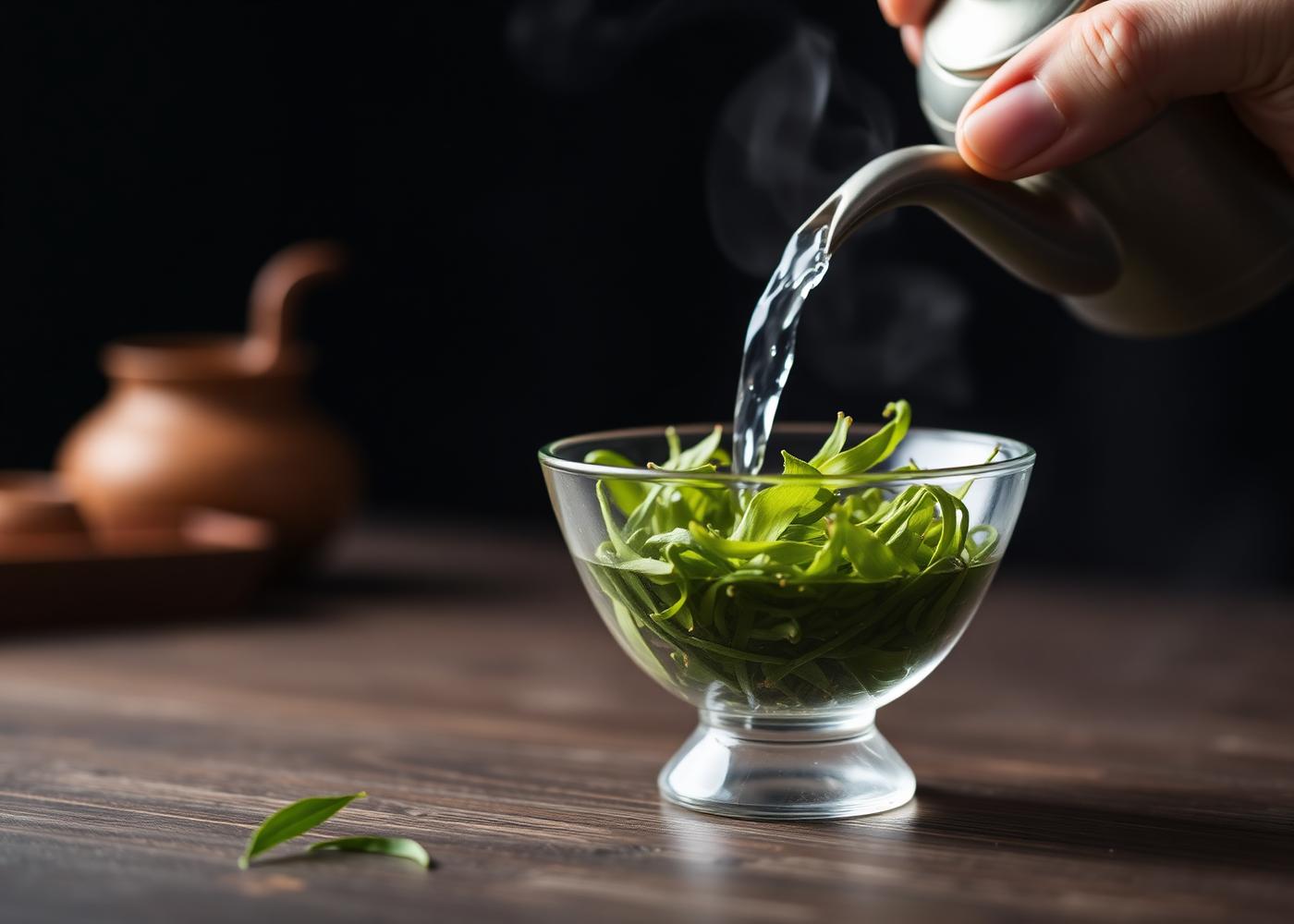
If you change one thing about how you make tea, change the water temperature. Not the leaf, not the pot, not the timer. Temperature governs which compounds leave the leaf and in what order, and getting it wrong by twenty degrees will ruin a good tea faster than any other error in the process.
The short version: catechins and caffeine — the bitter, drying, stimulating compounds — extract quickly and eagerly at high temperatures. Amino acids like theanine, which carry sweetness and that savoury depth good green tea has, extract readily at much lower temperatures. Boiling water pulls everything at once, and the bitterness simply shouts over the rest.
Why temperature matters more than time
We ran this as a paired test across forty cups. Same sencha, same 2 g in 6 oz, same filtered water. One set brewed at 165 °F for ninety seconds, the other at 205 °F for forty-five seconds — roughly matched for total extraction. The cups were not close. The hot-and-fast set was drying and vegetal in a way that tasted like a mistake; the cool-and-slow set was sweet and thick.
This holds in the other direction too. Black tea brewed at 175 °F for five minutes does not become a good cup of black tea. It becomes a weak, sour one, because the compounds you want out of a fully oxidised leaf need the heat to move at all.
The temperature ladder
| Tea | Temperature | Leaf | Time | Note |
|---|---|---|---|---|
| Gyokuro / shaded green | 140–155 °F | 4 g / 6 oz | 2:00 | Cooler and heavier than you expect |
| Sencha, first flush | 160–170 °F | 2 g / 6 oz | 1:10 | Above 180 it turns astringent |
| Chinese green (Longjing) | 175 °F | 2 g / 8 oz | 2:00 | More forgiving than Japanese green |
| White (Silver Needle) | 175–185 °F | 3 g / 8 oz | 5:00 | Low heat, long time |
| Oolong, light roast | 190 °F | 3 g / 8 oz | 2:30 | Or gongfu, 30 s rounds |
| Oolong, medium/dark roast | 200 °F | 3 g / 8 oz | 3:00 | Roast level raises the target |
| Black tea | 205–212 °F | 3 g / 8 oz | 3:30 | Full boil is correct here |
| Puerh (shou) | 212 °F | 5 g / 100 ml | Rinse + 20 s | Always rinse first |
| Herbal / tisane | 212 °F | 3 g / 8 oz | 5:00+ | Steep covered |
Hitting the target without a fancy kettle
You do not need a variable-temperature kettle. You need patience and one of these:
- The cooling clock. Boil, then let the kettle stand uncovered. In a normal room, freshly boiled water drops roughly 10 °F in the first minute, then more slowly. Two minutes gets you near 195 °F; five minutes gets you near 175 °F. Time it once with a thermometer in your own kitchen and the numbers hold from then on.
- The cold-water pour. Add one part room-temperature water to four parts boiling. That lands you around 180 °F, which is close enough for Chinese greens and white tea.
- The vessel transfer. Pouring boiling water into a cool ceramic pot drops it 10–15 °F immediately. Japanese tea culture built an entire object around this — the yuzamashi, a cooling bowl — which tells you it is a real effect and not a rounding error.
- Buy a $12 probe thermometer. Honestly, this is the answer. It removes the guessing entirely and costs less than a decent tin of tea.
Four mistakes we see constantly
Re-boiling water repeatedly. Each boil drives off dissolved oxygen, and low-oxygen water genuinely tastes flatter. We ran this blind with eight people; six picked the fresh water. Fill the kettle with what you need.
Using unfiltered hard water. Above roughly 150 ppm, calcium and magnesium bind with tea polyphenols and you get that dull film on the surface. Filtered water in the 40–80 ppm range is the sweet spot. Distilled water is the opposite mistake — with no minerals at all, the cup tastes hollow.
Judging temperature by the sound of the kettle. The “fish eye” and “string of pearls” stages in classical Chinese texts are real, but they describe an open pot on a fire, not a sealed electric kettle you cannot see into.
Ignoring altitude. Water boils at a lower temperature as you climb. At our elevation the kettle tops out near 199 °F, which means “boiling” here is not boiling in Chicago. We wrote a separate guide on the correction.